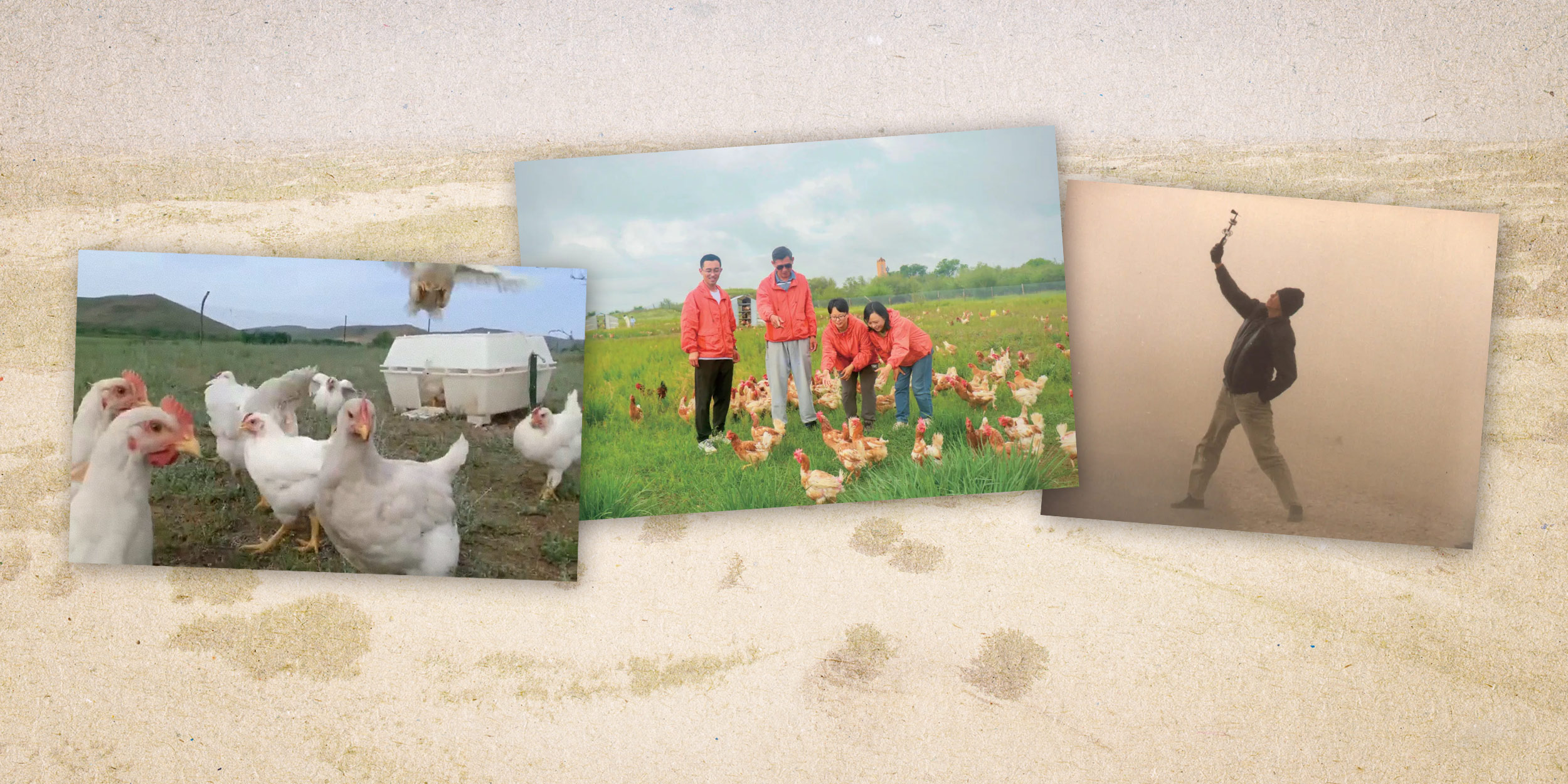
Poultry Returns: Botanist Fights Off the Desert With 50,000 Chickens
Editor’s note: Following is the transcript of a speech by Li Yonggeng, a researcher at the Institute of Botany, Chinese Academy of Sciences (IBCAS), from September 2025 on his team’s efforts to restore a degraded grassland in northern China through free-range chicken farming. The speech was released by Gezhi Talks, a scientific and cultural forum affiliated with the Chinese Academy of Sciences (CAS).
The place where I raise chickens lies in the Hunshandake Sandy Land, part of the Xilingol Grassland in the Inner Mongolia Autonomous Region. Sitting at an elevation of about 1,300 meters, it is one of northern China’s vital ecological barriers. Remarkably, it is only 180 kilometers from Beijing.
In 2001, during my postdoctoral research at the Institute of Botany, my fieldwork brought me to Hunshandake. When I arrived, I was struck by the vast, desolate landscape of drifting sand. Only a few stunted elm trees clung stubbornly to life, while herds of cattle and sheep wandered the barren ground with virtually nothing to graze on.
On April 7, 2002, I was caught in a severe sandstorm, giving me my first taste of the devastating power of a gale. Wind speeds reached 28 meters per second — roughly 100 kilometers per hour — making it nearly impossible to remain standing.
Hunshandake endures more than 60 days a year with winds exceeding Force 8 — corresponding to average wind speeds of 17.2 to 20.7 meters per second measured at a height of 10 meters, according to China’s wind scale. Once vegetation is degraded under such conditions, a region can quickly become a major source of dust storms.
To better understand the underlying causes, types, and severity of desertification in the area, my team and I undertook an extensive field investigation. In just over 90 days, we traveled more than 10,000 kilometers across the sandy land, searching for viable ecological restoration and land management strategies.
Abundant issues
Why had a once-thriving grassland deteriorated so severely?
Our analysis of historical data revealed a striking trend. Between 1950 and 2000, livestock numbers in the sandy grassland increased nearly tenfold. As a result, the grazing area available to each sheep was reduced from roughly 70 mu (about 11.5 acres) to a mere 7 mu (1.15 acres). Serious overgrazing had stripped the grassland of its vegetation cover, triggering both grassland degradation and soil desertification.
After identifying the cause, we launched a series of restoration trials. These included the removal of grazing livestock, artificial reseeding, aerial seeding, and the use of straw checkerboard barriers for dune stabilization.
Among all these approaches, removing grazing livestock proved the most effective. It required relatively little investment, produced rapid results, and allowed vegetation to recover naturally. After three years, the forage yield reached 2,600 kilograms per mu.
The results attracted considerable attention within the scientific community, and in 2007, the journal Science dispatched a reporter to cover our success.
Local herders were equally thrilled to see the lush vegetation return. The tall forage eased grazing pressure on surrounding rangelands and provided a critical source of winter fodder.
To our dismay, however, the results were only temporary. After seven years, forage yields began to decline once again. The grass became shorter and sparser, and signs of degradation reappeared.
We were puzzled. What was causing the ecosystem to falter?
Herders routinely harvest hay to feed cattle through winter. Yet, our monitoring data revealed that every harvest removed not only biomass but also substantial quantities of soil nutrients. After six consecutive years of harvesting, the nutrients in these once productive rangelands had become depleted. Without fertile soil, the grassland could no longer sustain vigorous plant growth.
One obvious solution was livestock manure, which is an excellent source of organic fertilizer. So we began investigating conditions in the surrounding rangelands.
We discovered, surprisingly, that no grass was growing on the cattle dung. When we turned the dung pats over, they were hard and compact on the outside, and wet inside, with none of the tunnels or holes typically created by insects. Basically, the dung wasn’t decomposing.
This led us to consider the insects that normally break down livestock waste: dung beetles. Once abundant across the rangeland, they had become exceedingly rare. Without them, cattle dung was no longer being recycled back into the soil.
A local herder, who also served as the community veterinarian, provided a crucial clue. Between 2005 and 2010, non-native cattle were introduced into the region. These animals interbred freely with native herds, producing distinctive crossbreeds known locally as “rainbow cattle,” named for their unusually varied and colorful coats. However, these animals were less resilient to parasite infestations and required treatment twice a year with macrocyclic lactones (antiparasitic medication).
The medication was perfectly safe for the cattle, and meat from treated animals posed no risk to consumers. Yet residues excreted in the dung had an unintended consequence: they were lethal to dung beetles. Their population declined sharply, and the natural decomposition process broke down. Cattle manure could no longer be converted into fertilizer. Instead, it accumulated on the grassland as waste.
That left us with a pressing question: with no fertilizer available locally, where could we find an alternative source of nutrients?
Eureka moment
Several years ago, when my team was living on the grasslands, we started keeping chickens to add some variety to our monotonous diets. To my surprise, I noticed that the rangeland where the chickens roamed produced more vigorous vegetation.
It struck me that chicken manure is an excellent organic fertilizer. I began imagining all the ecological benefits that raising chickens might bring.
On one hand, chickens could generate valuable agricultural products such as eggs and meat, creating an additional source of income. On the other, they could fertilize the soil, loosen compacted ground through scratching, disperse seeds, and even help suppress locust populations. I was thrilled. It felt as though I had discovered a silver bullet for ecological degradation.
In 2009, with funding from CAS, we adopted an intensive poultry-farming model, introducing 50,000 chickens. We had high hopes that these birds would help restore the vast areas of degraded grassland.
But the results ran contrary to our hopes.
First, the rangeland where the chickens grazed became barren. Areas that had once supported healthy vegetation began to desertify. We had promised the herders that we would help combat desertification, but we had actively worsened it.
The herders were understandably upset. One of them said to me, “Dr. Li, please find a way to restore my rangeland. I don’t care whether you keep raising chickens or not.”
At the same time, our chickens were dying off. The birds suffered repeated predator attacks and extreme weather events. Wildlife we had rarely seen before, such as badgers, suddenly appeared in droves, seemingly bringing their entire families along for the feast.
If a badger killed only one chicken each time, that would have been manageable. The problem was that they often killed far more birds than they could possibly eat. Once inside a chicken house, they would leave a trail of destruction. A single intrusion could result in more than 600 birds being killed overnight.
We grew increasingly exasperated, but no matter what defensive measures we took, we simply couldn’t keep them out.
There was also another problem we hadn’t anticipated. Chickens are highly prone to herd behavior. If one bird is startled and takes flight, the rest panic and follow. When the first bird lands, the others pile on top, and the mass can quickly reach more than a meter high, crushing and suffocating the birds at the bottom.
By the end of the year, 90% of our chickens had died before reaching market weight, resulting in enormous economic losses. With birds dying off in large numbers and herders demanding solutions to the worsening desertification, the pressure on us was overwhelming.
My colleagues advised me to quit. “You’re a plant scientist,” they said. “Your expertise is in vegetation, not livestock. This isn’t your field. Cut your losses, write papers, and apply for grants.” I was devastated.
Just as I was at my lowest point, I visited another experimental site consisting of 32 plots, each stocked with only 20 chickens. To my amazement, both the chickens and the surrounding vegetation were thriving.
That patch of grassland gave me renewed confidence.
We found that most chickens tend to forage near their shelter, with 85% never venturing beyond a 50-meter radius. When 1,000 or 2,000 birds are concentrated in a single flock, their tendency to remain near the coop can cause severe localized damage, degrading the surrounding vegetation. Moreover, large flocks are more vulnerable to mass panic, leading to crowding, suffocation, and large-scale mortality.
Raising chickens is something many farmers excel at. Yet despite holding a doctorate, I was making a complete mess of it.
Eventually, we changed our strategy and adopted small-flock rotational management. After experimenting with both triangular and square mobile coops, we developed a new type of mobile coop in 2025, which we dubbed “Coop V7.”
The structure combines a square base with a triangular roof and can comfortably house 600 laying hens. It is light enough to be towed across the grasslands by a small electric tricycle and can be relocated every three to five days. The coop is a fully integrated system equipped with automatic watering, roosts, and nesting facilities.
This coop is now being piloted in Inner Mongolia’s Zhenglan Banner, Beijing’s southern Daxing District, and Handan, in the northern Hebei province. So far, the field data and user feedback indicate that this system performs exceptionally well.
Home improvement
However, as a botanist, what mattered to me most was whether the grassland had truly recovered. The results were remarkable. The pastures where we implemented our poultry-grazing model in 2018 have remained highly productive, with forage yields more than three times those of the control plots.
The local herders have gradually embraced the idea of raising chickens. In many ways, it has become a valuable complement to traditional pastoral livestock production. To promote the model, we have organized meetings and training sessions to share its benefits, and we actively gather feedback from participants to refine our facilities and equipment.
One herder who adopted our system has transformed his small, humble house into a beautiful villa, dramatically improving his quality of life. He calls poultry farming his “mini ATM.”
Another herder has even taken up livestreaming. Broadcasting in both Mongolian and Mandarin, he sells chickens and eggs online while introducing our ecological farming model to a wider audience.
In the summer of 2025, numerous groups of visitors came to observe and learn. They were eager to use our mobile coops to fertilize their rangelands, generate additional income, and help control locust outbreaks by towing the coops across the rangeland so the birds could feed on the insects.
Seeing more people adopt our mobile coops fills us with deep satisfaction. The idea may once have seemed unconventional, but it has proven to be a practical way of giving something back to the grassland.
Through years of experimentation and persistence, we gradually rehabilitated this degraded sandy land. The ecological restoration and landscape conservation plan we developed for the Site of Xanadu (north of the Great Wall) also contributed to its successful inscription as a UNESCO World Heritage site.
Life in the Hunshandake Sandy Land has also improved steadily over the years. Before 2009, we didn’t even have a field station. We had to live with a herder’s family in a house that had only three rooms and no toilets, and no public facilities nearby. We simply had to make do. Taking a shower was out of the question.
In 2010, we finally built our own prefabricated field quarters. We each had a room, but the toilets were still outside, and bathing remained difficult. It was not until 2021 that we were able to use funding from CAS to refurbish the station and have rooms with private bathrooms.
More than two decades have slipped by in the blink of an eye. Now I harbor a new dream: to introduce my poultry-grazing method to suitable regions across the Eurasian Steppe, enriching people’s livelihoods while healing the fragile grassland ecology. We hope this model can offer a Chinese solution to one of the world’s most pressing environmental challenges: desertification.
We will continue this work, hoping that the Hunshandake Sandy Land grows greener with each passing day, and that the vast mountains and rivers of our motherland remain beautiful for generations to come.
A version of this article originally appeared in Gezhi Talks, a scientific and cultural forum in China organized by the CAS, showcasing interdisciplinary ideas through talks by distinguished figures from science, education, culture, and arts. It has been translated and edited for brevity and clarity, and is republished here with permission.
Translator: Chen Yue; editors: Wang Juyi and Hao Qibao.
(Header image: Visuals from IBCAS and VCG, reedited by Sixth Tone)